


Happy pre-TGIF. 
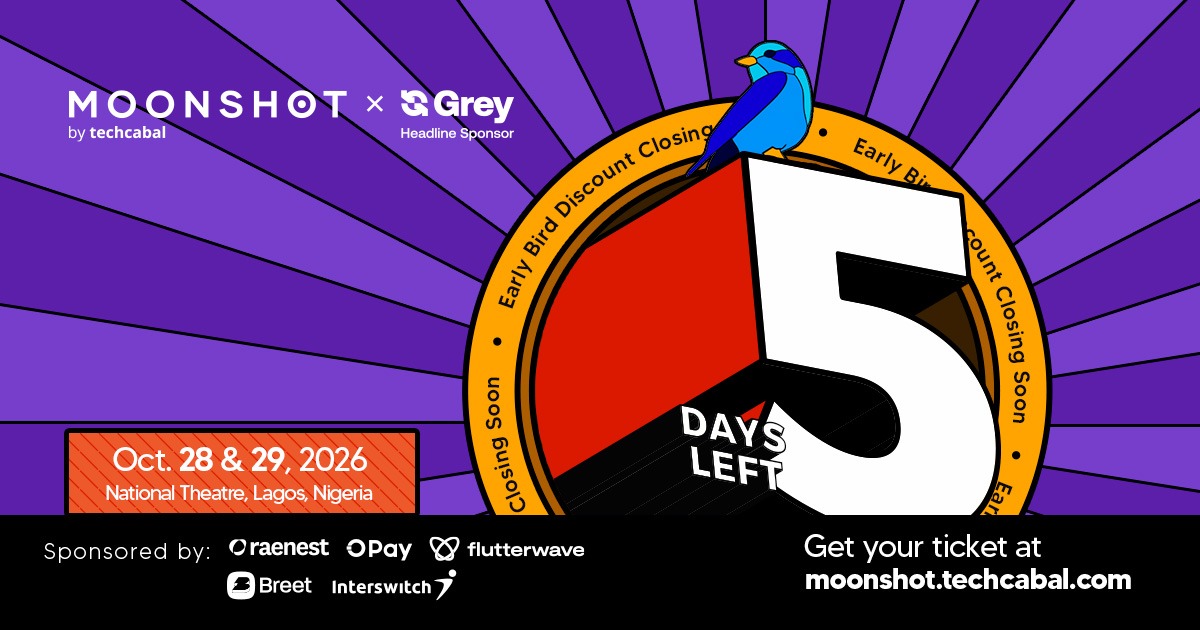
Final call to get your Moonshot 2026 ticket at 20% off.
This October, Moonshot brings founders, investors, operators, creators and talent together at the National Theatre in Lagos for two days of conversations, connections and opportunities. The Early Bird offer allows you and your network to get 20% off Moonshot tickets. Prices return to normal after it closes.
Get your Moonshot ticket at 20% off →
Become smarter about tech and commerce in Francophone Africa, and the policies shaping them. Read previous editions here first and subscribe below.

mobility
Uber, the ride-hailing giant, ends operations in Nigeria and Uganda

If you opened your Uber app in Nigeria or Uganda on Wednesday, hoping to get a ride somewhere, you may have been greeted by a “No trips available” message. For some users, the breakup message arrived straight in their inbox.
What happened? The ride-hailing giant has wound down operations in Nigeria and Uganda. Nigerian drivers were told they would no longer receive rider requests through the app, but it would provide a one-off goodwill payment to help them through the transition. The exits arrived the same day Uber announced plans to cut about 3,300 jobs, roughly 10% of its global workforce, to focus on ride-sharing, delivery and autonomous vehicles.
Explain like I’m new here: Uber arrived in Lagos in 2014 and launched in Kampala in 2016, as part of its African expansion. However, growing a ride-hailing market and making money from one are two different things. In Nigeria, Uber faced tension over fares and commissions. Drivers protested in March 2026, complaining about earnings and the economics of working on the platform. Rising fuel prices, vehicle maintenance costs, competition, and regulation have also made the balancing act harder. In August, the Federal Airports Authority of Nigeria (FAAN) tightened control over commercial ride-hailing operations at airports, restricting operators from picking up passengers.
What is Uber saying? Uber has not pointed to competition, driver disputes or FAAN’s restrictions as its reason for leaving. It said the decision followed a review of its business priorities and investment focus across Africa.
Is Uber low-key telling Africa goodbye? Uber left Côte d’Ivoire in September 2025, exited Tanzania in January, and has now left Nigeria and Uganda. This week, it also discontinued its budget UberX service in South Africa. Uber still operates in several African markets, including Kenya, South Africa, Ghana, and Egypt.
Even though the whole of Africa has not received a “it’s not you, it’s me” email from Uber yet, four market exits in roughly a year suggest Uber is becoming much more selective about which African rides it wants to keep taking.


Every business owner needs to watch this.

The business questions you Google, answered by experts. Watch for free.
mobility
Kenya blocks 18% ride-hailing commission cap in win for Uber and Bolt

Uber may be packing its bags in Nigeria and Uganda and cutting jobs along the way, but Kenya’s ride-hailing companies have something to celebrate.
What happened? The High Court has declared parts of Kenya’s National Transport and Safety Authority (NTSA) Regulations, 2022, unconstitutional. One of the rules capped the commission ride-hailing platforms could charge at 18% of a trip’s earnings. The court also blocked the NTSA from requiring platforms to keep detailed passenger and driver records, including trip locations, times, and payment details, for three years and hand them over to the authority when requested.
Explain like I’m new here: In 2022, Kenya decided the ride-hailing market needed some adult supervision. Drivers had complained that platforms were taking commissions of 25% to 30%, leaving them with less money after fuel, vehicle costs, and other expenses. If a passenger paid $2 for a ride, the platform would take its agreed percentage as commission before the rest goes to the driver.
So, the government responded with regulations covering licensing, vehicle standards, driver verification, and passenger safety. The new rules said commissions could not exceed 18%. Ride-hailing platforms, like Bolt (which filed a petition in 2025), were not so happy about that.
Now the court is on their side: The court ruled that the government failed to follow the proper constitutional and regulatory process when creating some of those rules. For the commission cap, the court said the government had not shown enough evidence to justify restricting how platforms price their services. For the data rules, it found that forcing platforms to store and surrender detailed information about riders and drivers created an overly intrusive surveillance system.
What happens now? The court has given the government 12 months to go back, do the required public participation and impact assessment, and fix the regulations. Until then, the disputed provisions cannot be enforced. That means the 18% legal ceiling is off the road for now, giving platforms more freedom to set commissions with drivers. Could rates eventually creep back towards the 25%–30% that triggered the regulations in the first place? Possibly, but that is left to be seen.
A survey for Nigeria’s health logistics buyers.

If you’re a Health Logistics Buyer in Nigeria, participate in our report by filling out the survey by 4 September. It takes less than 10 minutes.
companies
Pick n Pay’s grocery app had a bad delivery day

Pick n Pay’s asap! grocery-delivery service suffered a technical glitch on Tuesday that prevented stores from assigning orders to drivers. Some morning orders were still undelivered by the end of the day, while other customers were pushed into delivery slots the next morning. Pick n Pay said the issue affected its logistics partner, which it did not name, and advised customers to use Mr D, an alternate food and grocery delivery platform, in the meantime. It later said the problem had been resolved, affected customers had been refunded in full, and they had received a promotional code as an apology.
Why does this matter? The outage is awkward timing for Pick n Pay because online grocery is one of the retailer’s brighter growth areas. Its online on-demand sales grew 37.6% in the year to March 1, 2026, while Mr D’s grocery division recorded 38% growth and made a profit for the first time.
The incident shows the trade-off in app-based convenience: customers experience one Pick n Pay brand, even when the failure happens inside a separate logistics company. Pick n Pay can refund a missed order, but repeated delivery failures would make customers less willing to trust a service built around speed. The next test is whether the retailer can make its delivery network as dependable as the app and the supermarket behind it.
Moonshot is back!

Moonshot 2026 is coming! Join us at the National Theatre, Lagos on October 28 & 29 for two days of tech and innovation. Grab your early bird tickets now and get 15% off.
banking
South Africa’s First National Bank is experiencing online outages

For several hours on Wednesday morning, some customers of First National Bank (FNB), a South African commercial bank, could not reliably log in to their apps, access their accounts, or use the bank’s website. By the time FNB restored its services, some users had already resorted to the old-fashioned solution: refreshing the page and hoping.
What happened? FNB customers began reporting intermittent problems with online banking and the FNB app from around 08:30 a.m. local time. Some users managed to log in slowly, while others received error messages or a blank page. Reports began to subside around 09:45, but access remained sporadic until FNB said its banking services were fully restored at about 12:57 p.m.
Explain like I’m new here: Online banking isn’t a single switch. Customers rely on several connected layers: the website or app, login and authentication services, account information, and the systems that process transactions. A failure in one layer can leave someone staring at a blank screen even when the bank’s underlying accounts and payment systems are still running.
Zoom out: FNB’s app and online banking are not just extra channels anymore; for many customers, they are the bank. That makes a three-hour disruption more than a technical nuisance: it can stop people checking balances, paying bills, or moving money when they need to. FNB restored the service, but the useful question is whether it can explain what failed and give customers a dependable fallback the next time the screen goes blank.
CRYPTO TRACKER
The World Wide Web3
Source:

|
Coin Name |
Current Value |
Day |
Month |
|---|---|---|---|
 Bitcoin Bitcoin |
$77,743 |
+ 0.37% |
+ 21.64% |
| Ether |
$2,407 |
– 0.16% |
+ 29.09% |
| XRP |
$1.36 |
+ 1.38% |
+ 26.92% |
| Solana |
$100.85 |
+ 0.94% |
+ 36.78% |
* Data as of 06.04 AM WAT, September 3, 2026.
Opportunities
- Moonshot early bird ticket sales end in 6 days!
This is your chance to get your Moonshot 2026 ticket at 20% off the original price.
This October, Moonshot brings founders, investors, operators, creators, and talent together at the National Theatre in Lagos for two days of conversations, connections, and opportunities. The Early Bird offer presents a unique opportunity for you and your network to get 20% off Moonshot tickets. Prices return to normal after it closes. Get your Moonshot ticket at 20% off now to secure your seat in the rooms defining Africa’s next chapter


- Kenya’s new phone number rules will make recycling costlier for telcos
- Kenyan police arrest FlexPay founders over theft and fraud allegations
- My Life In Tech: Why an Imperial PhD candidate trusts herds of cattle more than satellites
- Cascador selects 10 Nigerian businesses for growth-stage accelerator
Written by: Yemi Kareem and Zia Yusuf
Edited by: Emmanuel Nwosu & Ganiu Oloruntade
Want more of TechCabal?
Sign up for our insightful newsletters on the business and economy of tech in Africa.
- The Next Wave: futuristic analysis of the business of tech in Africa.
- Francophone Weekly by TechCabal: insider insights and analysis of Francophone’s tech ecosystem
P:S If you’re often missing TC Daily in your inbox, check your Promotions folder and move any edition of TC Daily from “Promotions” to your “Main” or “Primary” folder and TC Daily will always come to you.
